
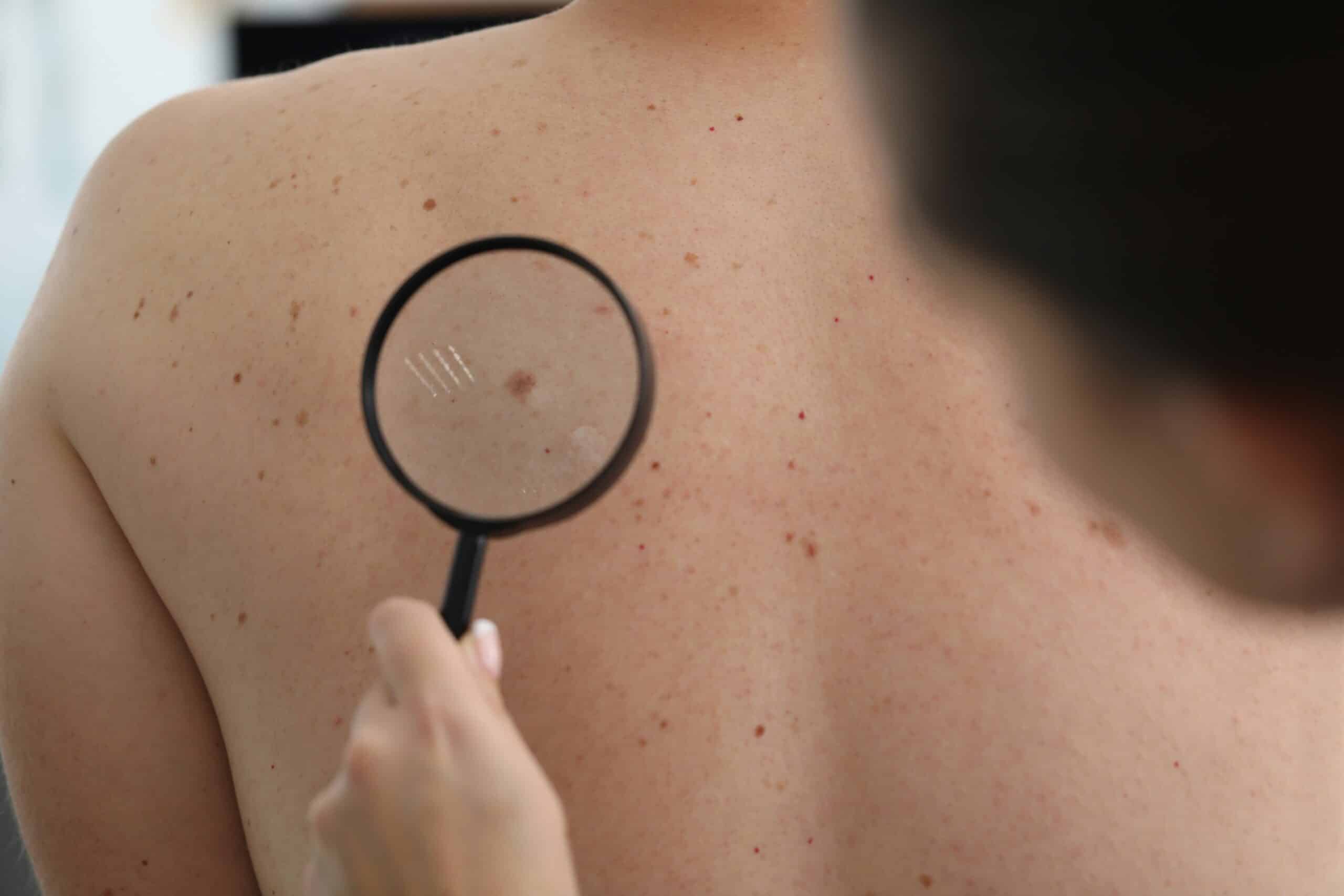
Most moles are completely harmless. They are one of the most common features on human skin, and the majority will never cause any problem at all. Even so, mole removal is one of the most frequent reasons people come to a dermatology clinic, whether for medical reassurance or for cosmetic reasons.
The single most important point to understand is this: a mole should be assessed before it is removed, not after. At our Mayfair clinic in London, consultant dermatologist Dr Jinah Yoo examines every mole properly before any treatment is considered, so that nothing significant is missed and the right method is chosen for your skin.
This guide explains when a mole genuinely needs checking, the different ways moles are removed, and what you can realistically expect from the process.
What Is a Mole?
A mole, known medically as a melanocytic naevus, is a small cluster of pigment-producing cells called melanocytes. Moles can be flat or raised, smooth or slightly rough, and range from light brown to almost black. Some are present from birth, but most appear during childhood and early adulthood, and their number and appearance can change gradually over a lifetime.
The vast majority of moles are benign, meaning they are not harmful. The reason dermatologists take them seriously is that, in a small number of cases, a changing or unusual mole can be the first sign of skin cancer, including melanoma. This is why assessment matters more than the removal itself.
When Should a Mole Be Checked?
You should arrange a professional mole check rather than simply requesting removal if you notice any of the following. Dermatologists often use the ABCDE guide as a simple prompt:
- Asymmetry – one half of the mole does not match the other.
- Border – edges that are irregular, blurred or notched.
- Colour – more than one colour, or uneven pigment within the mole.
- Diameter – larger than about 6mm, or noticeably growing.
- Evolving – any change in size, shape, colour or sensation over weeks or months.
Other features worth reviewing promptly include a mole that itches, bleeds, becomes crusty or fails to heal, or a new pigmented spot appearing after the age of around 30. None of these signs mean that something is wrong, but they are reasons to have the mole examined rather than ignored.
If you are at all concerned about a changing mole, please do not delay assessment in favour of cosmetic removal. A proper evaluation comes first.
Medical and Cosmetic Reasons for Mole Removal
People generally seek mole removal for one of two reasons.
Medical reasons include a mole that looks unusual on examination, one that is changing, or one that is repeatedly caught, rubbed or irritated by clothing, jewellery or shaving. In these cases removal is part of careful management rather than a purely aesthetic decision.
Cosmetic reasons are equally valid. Many patients simply feel self-conscious about a mole on the face or another visible area, or dislike a raised mole that interferes with make-up or shaving. Cosmetic removal is reasonable, but only once the mole has been confirmed as suitable for that approach.
How Mole Removal Is Done
There is no single technique that suits every mole. The right method depends on the type of mole, its depth, its location and, crucially, whether there is any clinical reason to examine the tissue afterwards. The main approaches are below.
Surgical excision
The mole is removed in full with a small surgical margin, usually under local anaesthetic, and the skin is closed with fine sutures. This is the preferred method whenever a mole needs to be sent for laboratory analysis, because it removes the whole lesion intact. It is commonly used for flat moles and for any mole that requires histology.
Shave excision
A raised mole is carefully shaved level with the surrounding skin using a specialised technique, again under local anaesthetic. Stitches are often not required, and healing tends to be quick. Shave excision is typically used for benign, raised moles rather than for lesions that need deeper removal.
Laser and radiofrequency methods
For certain small, benign and clearly diagnosed moles, energy-based techniques such as laser or radiofrequency can be used to treat the surface. These methods can be useful cosmetically, but they are only appropriate when there is no clinical reason to examine the tissue, because they do not preserve a sample for analysis. This is one of the reasons assessment beforehand is so important.
Why histology matters
If there is any clinical indication, removed mole tissue is sent for histology, where it is examined under a microscope by a pathologist. This is a standard safeguard that confirms the nature of the mole. It is also a key reason to have moles removed by a dermatologist rather than at a non-specialist setting, and why over-the-counter mole removal creams and DIY methods are strongly discouraged. They carry a real risk of scarring and, more importantly, of removing a mole that should have been examined.
What to Expect
Your first appointment is a consultation and assessment. Dr Jinah Yoo will examine the mole, often using dermoscopy, a handheld magnification tool that allows the structure of the mole to be seen in detail. This examination guides whether removal is appropriate and which method is most suitable.
If removal goes ahead, the procedure itself is usually short and carried out under local anaesthetic, so the area is numb. Most patients describe the experience as comfortable and well tolerated. Afterwards you will be given clear aftercare instructions to support healing and reduce the risk of infection.
Healing time varies with the method and the site. Surgical wounds with stitches take longer to settle than a shave site. It is realistic to expect some mark or change in the skin where a mole has been removed. Modern techniques aim to minimise scarring, but no responsible clinic can promise scar-free results, and anyone claiming otherwise should be treated with caution.
Risks and Realistic Expectations
Mole removal is a routine procedure, but like any treatment it carries some considerations:
- Scarring – some degree of mark is expected, varying with method, site and individual healing.
- Pigment change – the treated area may be slightly lighter or darker for a period.
- Infection – uncommon when aftercare is followed, but possible.
- Recurrence – a mole treated only at the surface can occasionally return, which is another reason method selection matters.
These points are discussed openly during your consultation so that you can make an informed decision.
The Dr Jinah Yoo Approach
Dr Jinah Yoo is a GMC-registered consultant dermatologist, and mole assessment sits firmly within medical dermatology rather than general aesthetics. At our clinic in Mayfair, the approach is consistent and safety-led:
- Every mole is examined, with dermoscopy where appropriate, before any decision about removal.
- The removal method is matched to the individual mole, not applied as a one-size-fits-all service.
- Tissue is sent for histology whenever there is a clinical reason.
- Cosmetic removal is offered only once a mole has been confirmed as suitable.
You can read more about Dr Jinah Yoo and her background in medical and aesthetic dermatology. The clinic also treats other benign skin lesions, including skin tag removal and wart removal, often as part of the same consultation.
Frequently Asked Questions
How much does it cost to remove a mole in the UK?
Cost depends on the number of moles, their type and the method used, as well as whether histology is required. Because every case is different, a clear price is given after your consultation and assessment, once the most suitable approach has been agreed.
Will the NHS remove my mole?
The NHS generally removes moles only when there is a clinical reason to do so, for example if a mole is suspicious and needs investigation. Removal for cosmetic reasons is not usually available on the NHS, which is why many people choose a private dermatology clinic for this.
How do I get a mole removed in London?
The first step is a consultation with a dermatologist, who will examine the mole and advise whether removal is appropriate. If it is, the procedure can often be arranged straightforwardly afterwards, with the method chosen to suit the specific mole.
Are mole removals worth it?
For a mole that is changing or causing concern, assessment and any necessary removal offer genuine peace of mind. For a cosmetic mole that affects your confidence or is repeatedly irritated, many patients find removal worthwhile, provided it is done safely and after proper assessment.
Does mole removal hurt?
The procedure is carried out under local anaesthetic, so the area is numbed beforehand. Most patients find it comfortable, with only minor sensation during treatment and little discomfort afterwards.
Arranging an Assessment
If you have a mole you would like checked or are considering mole removal in London, the safest starting point is a proper assessment with a consultant dermatologist. To discuss your concern and the most suitable approach, you are welcome to book a consultation at our Mayfair clinic.